How To Start a New LARP - Part 6
The Logistics Side of LARP - A Checklist for Success
Introduction
By the time your LARP is up and running, the story and community are only part of the equation. What keeps everything moving smoothly from event to event is logistics, the systems, processes, and decisions that happen behind the scenes.
Good logistics don’t draw attention to themselves. Players shouldn’t have to think about them. But when they’re missing, everyone feels it. Taking the time to build clear, repeatable processes, and supporting them with the right tools, will save you time, reduce stress, and create a more consistent experience for your players.
Systems or platforms like LARP Portal, are designed specifically to handle LARP logistics. The key is choosing or building a system that fits your game and supports your workflow. While there are other systems, I believe LARP Portal stands out for its depth of features and its ability to manage nearly every aspect of LARP logistics in one place.

Build Systems, Not Just Solutions
It’s easy to solve problems as they come up. It’s harder, but far more effective, to build systems that prevent those problems in the first place. As we have done in other parts of this blog series, we are considering ongoing LARPs that hold multi-day events for demonstration purposes. You can make adjustments based on your game type.
Think about your event flow from start to finish.
- How do you notify players of event dates and event locations?
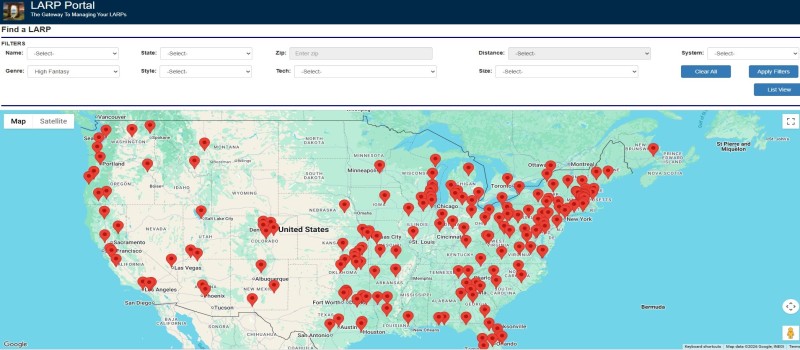
- Can they find you when searching “LARP near me”? Or LARPs in CA, LARPs in CO, LARPs in FL etc.?
- Where does a player go to sign up for your game?
- How does a player build and define their character?
- How do players register for an event?
- What happens when they arrive on site?
- What cabin or room is assigned to each player or team of players? How about NPCs?
- Do they sign up for food service?
- How are characters updated?
- How do they sign up to donate items or services?
- How do you handle in-between game skills, such as production or info skills?
- Can you search across all character histories? How about PELs (Post Event Letters)?
- Where does information go after the event?
Document your answers, then look for ways to centralize your processes. Tools like LARP Portal allow you to create structured workflows so your team isn’t reinventing the process every event.
If you are using spreadsheets or Google forms, inconsistent data can result in errors and more effort. For example; what issues result when “Robert Smith” signs up for your games, and “Bob Smith” registers for the event, Rob Smith emails you to ask to be housed with his team, etc?
With a LARP logistics system, your processes live in one place, data is centralized and consistent, which saves time and effort.
Streamline Event Registration
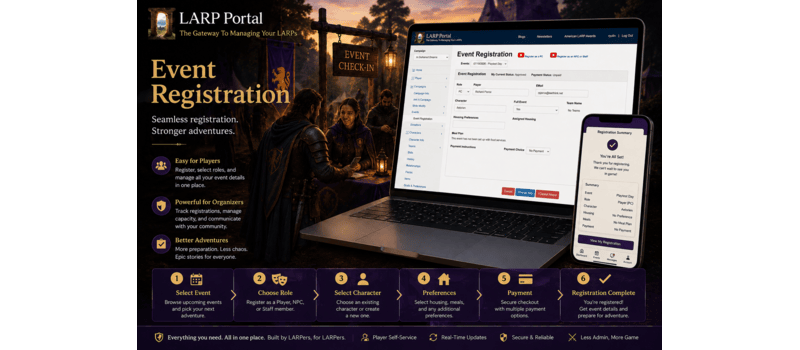
Registration is your first point of interaction for every event, and it sets the tone.
Keep it simple. Collect the information you actually need, event date, PC or NPC, character choice, housing choice, payment, and any relevant notes. Avoid overcomplicating forms or requiring unnecessary steps.
Registration systems that handle sign-ups, payment tracking, and player communication in one place are preferable to a mix of forms, spreadsheets, and payment apps to reduce errors and save time.
Make sure confirmation is clear. Players should know they’re registered, what they’ve signed up for, and what to expect next.
Create Efficient Check-In/Check-Out Processes
The check-in table is where your preparation meets reality.
Have a clear system for verifying registrations, collecting any remaining payments, and distributing materials. Whether that’s character cards, wristbands, or event info, everything should be organized and easy to access.
When your registration system ties directly into your event tools, as it does with LARP Portal, you can quickly confirm attendance and access player details without digging through multiple lists. This keeps lines moving and reduces confusion.
Assign specific roles to your team. A smooth check-in gets players into the game faster and starts the event on a positive note. A dedicated check-out location and instructions can greatly streamline and improve event close processes.
Manage Character Builds and Updates
Character systems are at the heart of your LARP, and are the most time-consuming of all LARP logistics if it’s handled manually by staff.
A character build refers to the selection of race, skills, spells, and traits that describe a character’s abilities and qualities to be used in-game. A character is built by “spending” character points (build points, experience points, etc.) on a predefined list of rulebook options.
Characters can further be defined by the player with descriptions from optional themes that do not have a cost associated. These non-cost items can add versatility and “flavor” to your game.
Are your character updates handled by staff or by the players?
Are they handled in spreadsheets, Google forms, or a character database?
A LARP logistics platform allows players to manage their own character builds. This requires a system that can handle complex logic to enforce your rules system, including all prerequisites, exclusions, and limitations, such as skills that are conditionally available.
Incorporate Character Histories
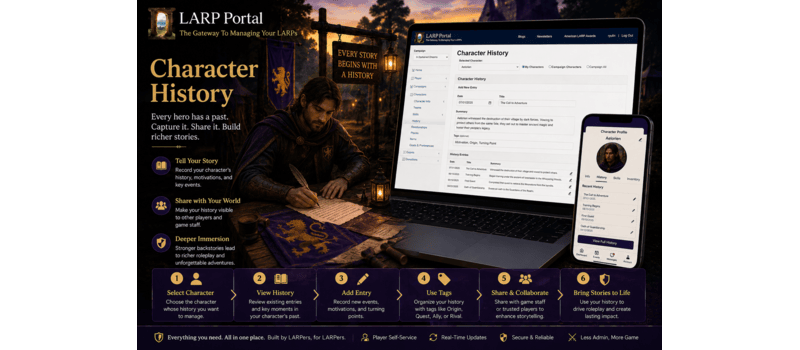
For many players, their character’s story is just as important as their stats.
Create a process that encourages players to submit, and plot teams to incorporate, character histories. A history need not be long or complicated to give staff an understanding of the character and how they fit into the world. When staff acknowledge these histories in-game, players feel seen and invested.
A logistics system should allow players to upload and maintain character histories alongside their sheets, making them accessible to staff when planning plots. Other tools can support this as well, but having histories connected directly to characters and events adds a layer of usability that’s hard to replicate.
Collect PELs and Use Feedback To Enhance Your Game
Post-Event Letters (PELs) are one of your most valuable tools. You might also call them surveys or questions-and-answers.
PELs give players a chance to reflect, share feedback, and highlight moments that mattered to them. For staff, they provide insight into what worked and what didn’t.
When PELs are incorporated in a centralized logistic system, tying responses to events, characters, and NPCs, incorporating feedback is simplified. A system makes it easier to review and act on PELs. PELs that are handled via Google forms or email can work, but often this requires more manual organization.
Just as important, take the time to review feedback. Look for patterns, not just individual comments, and use that information to guide future decisions. Reports designed to search cross-event and summarize responses to specific questions can provide great insight.
Track Donations and Community Support
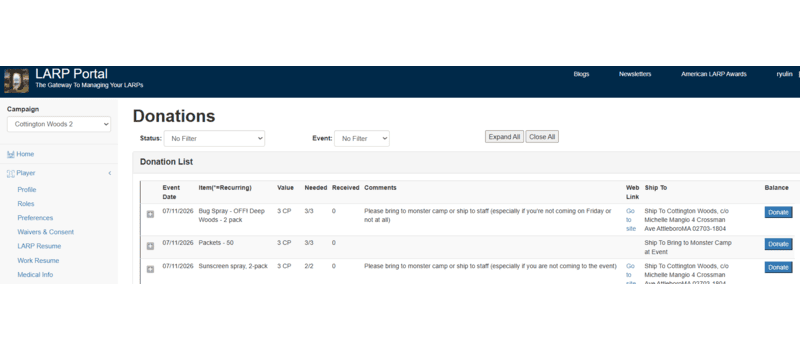
Some players often want to contribute beyond their event fee. Whether through donations, props, or time, you need a process to list items that you need, players need the ability to tell you they will donate those items, and you may need to reconcile the donation in some way, closing out the ask, and possibly assigning points.
Create a clear way to list donation opportunities and track and acknowledge player contributions. Transparency matters here. Players are more likely to support your LARP when they see how those contributions are used.
Keep Character Cards and Records Updated
Character cards are often the most visible representation of your system. A reliable system for character records keeps gameplay running smoothly. This is the area we see the most need for customization to meet staff and player needs.
Is the card used in-game by staff for validation or just by players as a reference?
Is the card used in-game to track currency, attributes, or to record updates?
Is the card turned in at the end of the game for manual updates?
Does the player customize for incants or to sort and organize based on refresh time?
Character cards are as unique to the game as to the character. A LARP logistics system that provides full configuration flexibility to define what is and isn’t on the card, where information is displayed on the card at the same time as giving the player customization options is ideal.
LARP Portal collected feedback on character cards for over 10 years. That is how we can say with confidence that this is a logistics need with the most customization needed. The issue is that customization is often cost-prohibitive. The cost to customize each game with exact specifications was always deemed too high.
We added to our roadmap and searched for an alternative to customization. In 2026, we launched a fully configurable character card module that allows the game to decide the card attributes and if players are able to customize. No other LARP logistics system has this level of customization, even home-grown systems.
Reporting - Stay Organized Behind the Scenes
All of these processes, registration, check-in, character management, and feedback generate information. Keeping that information organized and reportable is what makes everything else possible.
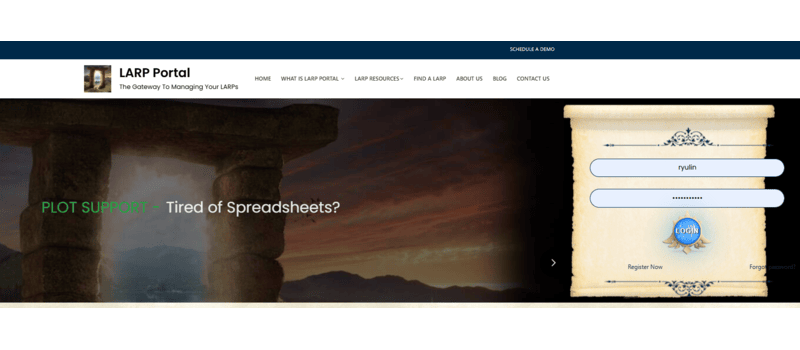
Some groups manage this with a combination of spreadsheets, cloud storage, and communication tools. Others choose an all-in-one platform like LARP Portal, which centralizes data and reduces the need to switch between tools.
Reporting is simplified with centralized data
- Event registrations by player type, PC, NPC, and staff, that includes housing assignment, payment status, etc
- Check in/Check out
- Player Master File that includes contact info, pronoun preferences, etc.
- Character Master file that includes total points, available points, last event attended, etc
- Skill Count by event
- PEL or History keyword search
- PEL Response Summary by question
While there are multiple ways to manage logistics, having a single, purpose-built platform with robust features and a suite of reports can dramatically simplify your workload, and LARP Portal currently offers one of the most comprehensive solutions available for LARP organizers.
Closing
Managing logistics may not be the most visible part of running a LARP, but it’s one of the most important. When your systems are clear, your processes are consistent, and your tools support your workflow, everything else becomes easier. Players spend less time waiting and wondering, and more time engaging with the story and each other.
And that’s the goal. A well-run LARP feels effortless from the outside, even though a lot is happening behind the scenes to make it that way. With strong logistics, and the right tools in place, your game isn’t just running...it’s ready to grow.
This blog concludes our 6-part series “ Starting a LARP”. The series is targeted at players considering running a LARP, but we hope that it is useful for all players, even those that stumble upon it searching for “WHAT is LARP?”.
- Part 1: The Top 5 Considerations When Starting a LARP
- Part 2: The 6-Step Process to Starting a LARP – From Idea to Event
- Part 3: Staffing Your LARP – How To Build a Core Team
- Part 4: The Creative Side of LARP – What Story Do You Want To Tell
- Part 5: The Business Side of LARP – Pointers From the Experts
- Part 6: The Logistics Side of LARP – A Checklist for Success
Call to Action
If you are a game owner or are thinking about starting a game, let LARP Portal simplify your administrative processes and give you and your players more time for LARPing. Contact us at demo@larportal.com today for a free demo.
If you would like to market your LARP and be listed in our Find a LARP search tool, contact us at support@larportal.com. This is a great tool for anyone who is searching for LARPs near me.
Latest Blogs




.png )




.png )